









Dubai vs. Istanbul: Which City Offers Higher Real Estate Investment Returns in 2026?

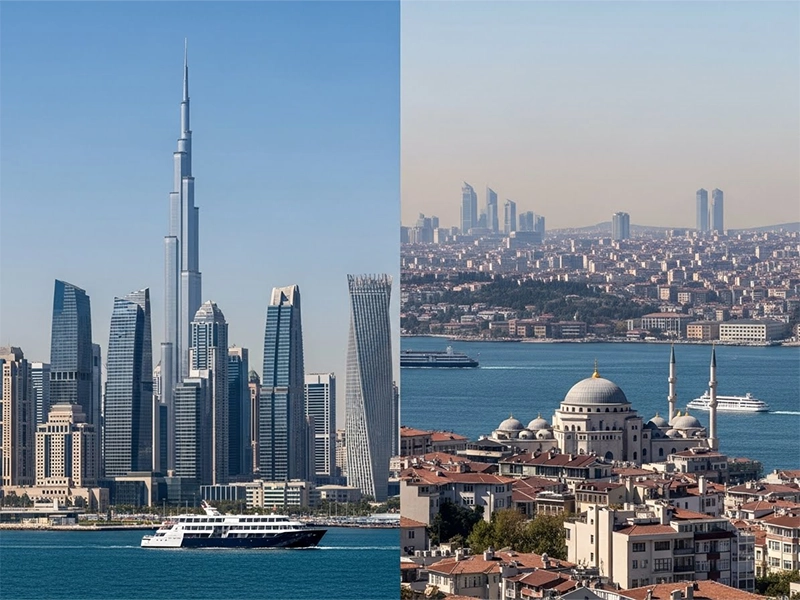
Investors looking at international real estate in 2026 often narrow their focus to Dubai and Istanbul. Both cities attract foreign capital, offer different return profiles, and serve distinct investor strategies.
But when it comes to real estate investment returns, which city actually performs better in 2026?
This guide breaks down the comparison in a clear, data-driven, and non-promotional way, helping investors understand how returns work in each market — before making any decisions.
2026 Quick Answer
Short answer: Dubai vs Istanbul ROI in 2026
- Dubai generally offers more stable rental yields with lower currency risk and clearer regulations.
- Istanbul often presents higher upside potential, driven by price gaps and long-term appreciation.
- Dubai suits investors prioritizing predictable income, while Istanbul attracts those comfortable with longer-term growth cycles.
- In 2026, returns depend more on strategy and timing than on the city alone.
Why Investors Are Comparing Dubai and Istanbul in 2026
Global investor demand and capital flows
Both Dubai and Istanbul sit at strategic crossroads between continents. Dubai continues to attract international capital from Europe, Asia, and the Gulf, while Istanbul benefits from regional demand, population growth, and cross-border interest.
Currency, inflation, and yield differences
Dubai operates in a USD-pegged environment, offering currency stability. Istanbul, on the other hand, reflects local currency dynamics, which can amplify both risk and return for foreign investors.
Lifestyle and residency incentives
Dubai’s long-term residency programs and Istanbul’s citizenship-by-investment pathway both play a role in investor demand, indirectly influencing property values and rental performance.
Request pricingReal Estate Market Snapshot: Dubai vs Istanbul (2026)
Dubai real estate market overview (2026)
Dubai’s property market is known for:
- Structured rental systems
- Strong short-term and long-term rental demand
- Transparent foreign ownership rules
The city’s market maturity reduces volatility, making returns more predictable but sometimes less aggressive.
Istanbul real estate market overview (2026)
Istanbul’s market is shaped by:
- A growing population and urban expansion
- Domestic and foreign demand overlap
- Long-term redevelopment zones
Returns in Istanbul often rely more on capital appreciation over time rather than immediate rental yield alone.
ROI Explained: How Returns Are Calculated in Each City
Rental yield vs capital appreciation
Real estate ROI comes from two sources:
- Rental income (annual net rent)
- Capital appreciation (property value growth)
Dubai tends to emphasize rental yield, while Istanbul often leans toward appreciation.
Short-term vs long-term ROI logic
Short-term strategies focus on rental cash flow. Long-term strategies focus on buying early in growth areas and exiting after appreciation cycles mature.
Gross vs net return
True ROI must account for:
- Service charges
- Maintenance costs
- Taxes and fees
Ignoring these can significantly distort return expectations in both cities.
Dubai ROI Profile: What Investors Typically See
Average rental yield ranges
Dubai rental yields vary by property type and location but are often considered competitive among global cities.
Capital appreciation patterns
Price growth in Dubai tends to follow market cycles, with periods of consolidation followed by expansion.
Risk factors affecting ROI
- Oversupply in certain districts
- Market timing
- Regulatory updates
Overall, Dubai’s risks are usually structural rather than systemic.
Istanbul ROI Profile: What Investors Typically See
Rental yield ranges in Istanbul
Rental yields in Istanbul vary widely depending on district, property age, and tenant profile.
Capital growth potential
Istanbul often shows strong appreciation potential in:
- Developing districts
- Infrastructure-linked zones
- Regeneration areas
Currency impact on returns
Currency fluctuations can either boost or reduce effective ROI for foreign investors, depending on entry and exit timing.
ROI Comparison Table
Dubai vs Istanbul ROI comparison (2026)
| Factor | Dubai | Istanbul |
| Rental yield stability | High | Moderate |
| Capital appreciation potential | Moderate | High (long-term) |
| Entry price range | Higher | Lower |
| Currency exposure | Low | High |
| Market liquidity | High | Moderate |
| Regulatory clarity | Very high | Moderate |
| Foreign ownership ease | High | High |
| Exit flexibility | Strong | Depends on market cycle |
What Type of Investor Fits Each City?
Dubai suits investors who prioritize…
- Predictable rental income
- Currency stability
- Regulatory transparency
Istanbul suits investors who prioritize…
- Long-term capital growth
- Lower entry prices
- Exposure to emerging-market upside
Common investor mistake
Choosing a city based solely on advertised ROI numbers, without aligning the investment with personal risk tolerance and time horizon.
Key Risks That Can Affect Returns in 2026
Market cycle risk
Both markets move in cycles. Entering late can compress returns regardless of city.
Regulatory and policy risk
Policy updates, taxation changes, or zoning rules can affect net returns.
Over-optimistic ROI expectations
Marketing projections often assume ideal conditions. Actual returns depend on execution, costs, and holding period.
Dubai vs Istanbul: ROI Myths vs Reality
“Dubai always guarantees higher returns”
Reality: Dubai offers stability, not guarantees.
“Istanbul is only for long-term investors”
Reality: Some strategies target shorter cycles, but patience improves outcomes.
“Off-plan always gives better ROI”
Reality: Off-plan returns depend on location, timing, and delivery quality.
Which option are you interested in?
Great! Please fill the form below.
Final Takeaway: Which City Offers Better Returns in 2026?
The smarter question to ask
Instead of asking “Which city is better?”, experienced investors ask:
“Which market aligns with my risk profile, time horizon, and return expectations?”
In 2026, Dubai and Istanbul offer different paths to ROI — and understanding those differences is the real investment advantage.